
72 and . . . Improving?
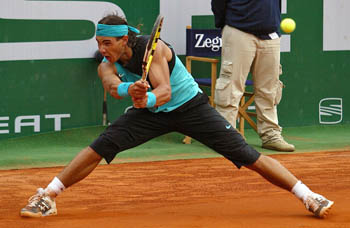
I don’t think I realized just how dominant Rafael Nadal has become on clay until yesterday. First, he played one of the best matches I’ve seen from him in a long time to beat a very game Guillermo Cañas for the Barcelona title. Afterward, I was talking to a friend about his win streak on dirt, which now stands at 72. I mentioned that the all-time record is 125 wins in a row on clay, which Chris Evert set between 1973 and 1979—yes, she didn’t lose on clay for six years. My friend asked if I thought Nadal had a chance to break that. In the past, Evert’s record has been one of those that leave you a little stunned when you hear about them—it usually elicits an incredulous “What?” There's never been much doubt that it’s unbreakable. It would be laughable…to…even…think…about….
Wait, why was I hesitating before I told my friend to forget it, that Nadal would never get anywhere near Evert? I finally said he couldn’t do it, but for a second it didn’t seem completely far-fetched; after all, he’s only 53 wins away.
For the record, I don’t think Nadal will get to 125, but after watching him out-hit and out-grit one of the grittiest guys around, I’m not exactly sure how he’ll be beaten. Both guys came out at top speed; Cañas even had two break points in the first game, and it seemed for a second or two that his defensive style might throw off Nadal by turning the tables and forcing the Spaniard to hit three winners just to secure a single point.
Of course, that’s just what Nadal did. He came back to hold in the first game, which kept Cañas from getting any sort of early edge, something that seemed essential after his long match the day before. Instead it was Nadal who responded by upping his level, both defensively and offensively. He may have been the heavy favorite, but as usual he played with the unembarrassed hunger of an underdog. His scambling, desperation backhand passes, which he managed to place at Cañas’ feet, reminded me of his vintage stuff from 2005, when he seemed to have invented a whole new way to play offensively while careening around far behind the baseline.
Nadal was also in fine attacking form. His serve is much flatter and faster than it was a couple years ago, but at the moment he hasn’t sacrificed anything in first-serve percentage. He also seems to be taking his forehand earlier, with slightly less backswing, and cracking it flatter than in the past, particularly down the line. Ditto on the backhand, which was a weapon both crosscourt and down the line all match. Nadal wasn’t grinding Cañas down yesterday the way he does Roger Federer; instead he was sending the Argentine from corner to corner. More than once, Cañas ended a point doubled over. After one long exchange late in the second set, Nadal extricated himself from another dire situation with a clean pass. Cañas looked at him in disbelief and flipped his palms upward, as if to say, “That’s just not right.” Nadal has spent a good portion of the last two years trying to improve on faster surfaces. Will that work end up benefitting him even more on clay?
Cañas should be commended for hanging in. He wasn’t in awe of Nadal, and he tried to change tactics and shorten the points in the second set by getting to the net (didn’t work; emphatically didn’t work; but that’s not a reason for you to forget that strategy, Roger; it really isn’t Willie’s game). Down 3-5 in the second, he struggled through a five-deuce game to hold, and down double match point, he did some spectacular scrambling of his own to win one of the longest points of the match and stave off defeat for another minute. Cañas will be a welcome addition to the Roland Garros mix.
As for Nadal, he’s now 20-3 in finals in his career and has suddenly won more matches than anyone else in 2007 (how quickly things change). To get an idea of how strong he is on clay right now, let’s go back to the final game. Serving at 40-15, he had Cañas dead to rights more than once with his forehand, but the Argentine just refused to miss. When he came back to win that point, Cañas looked energized and poised to make a run. So on the next point, Nadal made sure his forcing inside-out forehand was just a little better—deeper, wider—than it had been on the previous point. In other words, he made sure it was too good. That’s what 72-straight-win confidence looks like. Can you imagine it at 125?