The Pro Shop

Gear Talk: Wilson's John Lyons, Part 4

Saturday, September 15, 2012 /by

In the fourth and final part of my conversation with Wilson’s John Lyons, Global Product Director for racquets and strings, we discussed the verity of racquet aerodynamics, as well as a new handle technology the company plans to launch in 2013: Amplifeel 360. (Please also see part one, part two, and part three.)

Justin diFeliciantonio: We’ve talked at length about Wilson’s efforts to help recreational players generate more spin with SpinEffect. Of course, racquet-head speed is also factor in spin generation. Have you done any work on racquet aerodynamics? Is this something that should be taken into consideration?

John Lyons: To some degree, I think there’s a perception among players that racquet aerodynamics correlate with racquet-head speed—that if the racquet has a certain shape, it’ll move faster through the air. But the truth is that the stringbed actually creates more drag than the frame. 55 percent of a racquet’s drag stems from its strings.

Further to the point, people typically use examples of airplanes or cars when thinking about aerodynamics. But the problem is, airplanes and cars move in one direction; on the other hand, tennis racquets are moving in all different directions during the swing. Sometimes a racquet is moving vertically, sometimes horizontally. It’s just not moving in one direction. From our perspective, we haven’t found much evidence suggesting that a racquet’s aerodynamics can significantly influence players’ swing and spin production.

JD: Okay, so Wilson’s approach to generating spin is about amplifying the snap-back. Apart from SpinEffect, is the company introducing any other new technologies in 2013?

JL: We’re introducing a new handle system next year. It’s called Amplifeel 360, and will also be in the new Steam 99S and 105S racquets. It improves upon our first-generation Amplifeel handle, which integrated basalt fibers. As you know, we engineer our racquets with basalt. It’s a volcanic rock, essentially, that’s melted down into a fiber at very high temperatures and woven into the carbon construction. The material has natural vibration-dampening qualities. That’s why it’s used in things like camera tripods, as well as buildings to make them less sensitive to earthquakes. It definitely improves the feel of our racquets and handles.

JD: And Amplifeel 360? How’s it different from the original Amplifeel?

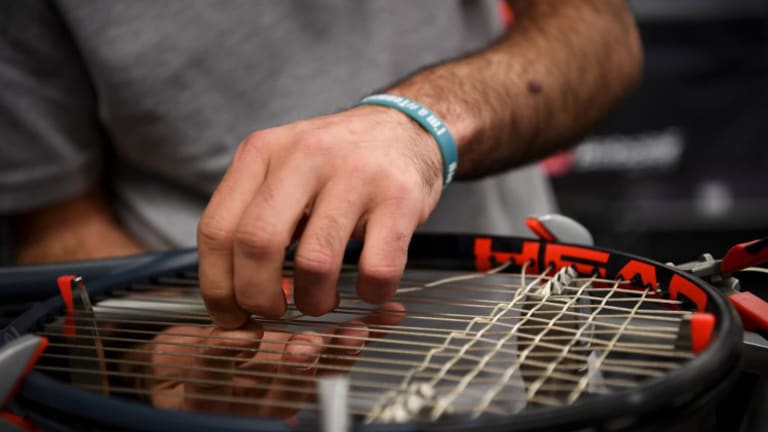
JL: So the original version of Amplifeel—if you remove the grip and just look at the bare handle, it looks like it’s made of foam. But sunken into this foam are cavities, where we drop six inserts of carbon and basalt. With Amplifeel 360, the whole handle is made up of basalt and carbon. Instead of starting with foam, we’ve expanded the graphite out to form the handle.

JD: So no foam?

JL: No, there’s foam. We’ve designed the basalt/graphite material with valleys to retain the foam, as opposed to molding cavities and dropping basalt into the foam itself. Now, when you remove the grip, the black of the handle you see is the composite material of the racquet. It’s not something we insert in afterwards.

JD: What’s the advantage of designing the handle in this way?

JL: The new basalt/graphite construction still filters out jarring vibrations and improves the racquet’s feel. But because it’s hollow, it also increases the handle’s stiffness. Amplifeel 360 strengthens the lower third of the racquet by about 15 percent, which increases the racquet’s power. (Any time we can make a racquet stiffer, it increases the amount of energy that goes back into the ball, because less energy is going into making the racquet bend.) Additionally, the new handle allows us to take grams of foam out of the handle. This gives us the option of taking some weight out of the racquet, or using those grams elsewhere to make the racquet stronger and more powerful. So with Amplifeel 360, you get a little more power, a lighter racquet, and better feel.
 

Click here to read TENNIS.com's posting guidelines before leaving a comment.