
Rome Previews: Iga Swiatek looks to keep things rolling in Elina Svitolina rematch
The two close out Thursday's action with a trip to the final on the line.
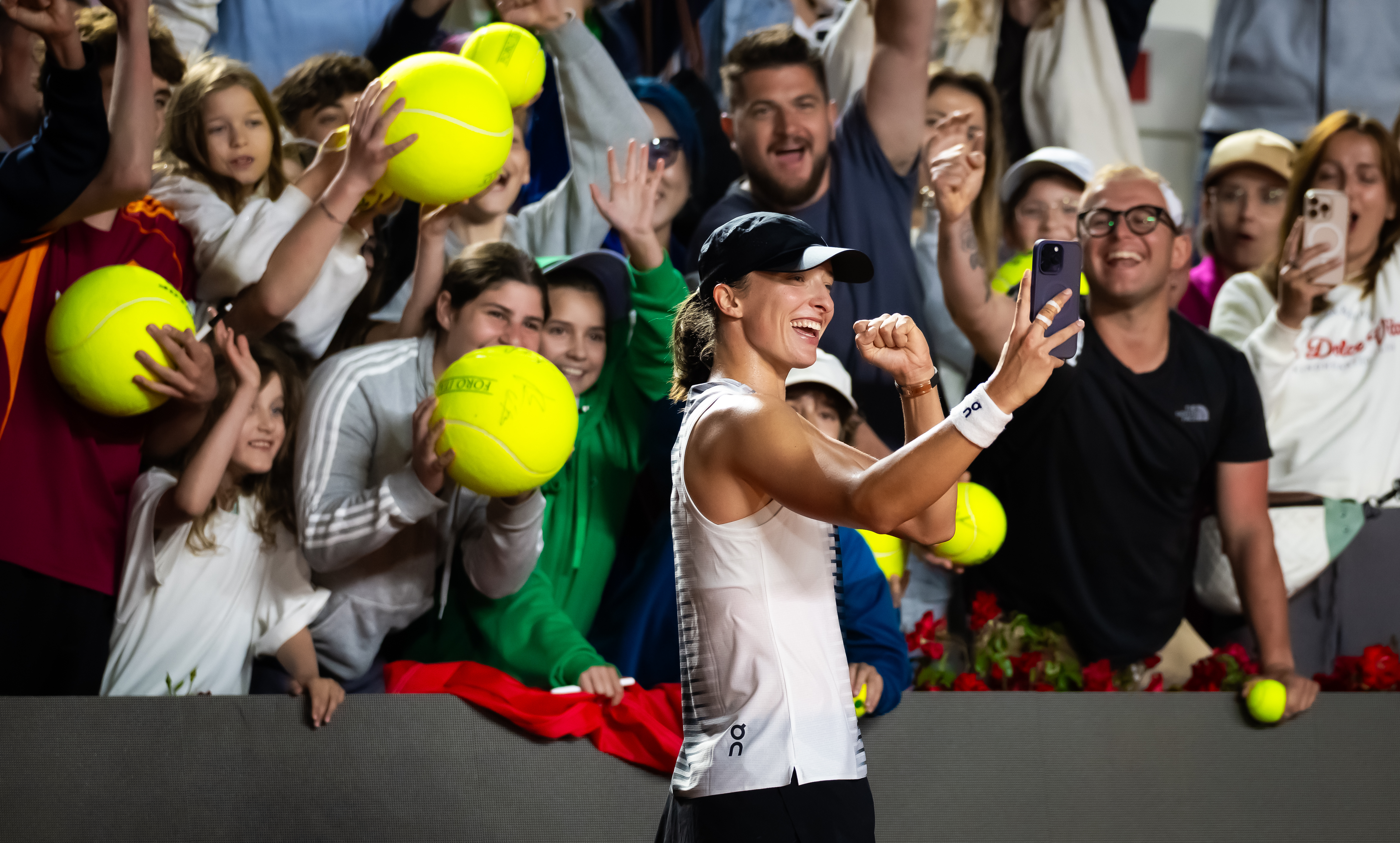
Iga Swiatek vs. Elina Svitolina
Part of me was hoping that this would be showdown between Swiatek and Elena Rybakina, two of the leading contenders for the Roland Garros title. But Svitolina more than earned her semifinal spot by willing herself to come back and beat a seemingly unbeatable Rybakina in three exceptionally hard-fought sets on Wednesday.
Her reward is a task that may be even more Herculean: Facing a newly sharp and confident Swiatek, on her favorite surface, less than 24 hours later.
Swiatek leads their head-to-head 4-2, and is 2-0 on clay; their first encounter came five years ago in Rome, and Iga won 6-2, 7-5. But most of those matches happened before the 31-year-old Svitolina resurrected herself in 2026. This season she’s 26-7, with a title and a Top 10 ranking again. Most important for our purposes, she beat Swiatek in three sets in Indian Wells just a couple of months ago.
That day, Svitolina jumped out early by doing what she has been doing better than ever this season: Attacking, with her serve, her forehand, her backhand, and her transitions to net. She’s still not the most powerful player on tour, but she has shifted from counter-puncher to puncher this season with hardly a hitch, and it worked against Swiatek on hard courts.
Getting it to work on clay, of course, will be a slightly different story. Svitolina is a fine dirt-baller, particularly so in Rome, where she won the title in 2017 and 2018. But that was in the pre-Iga era, which began when Swiatek won her first Roland Garros in 2020. Her heavy topspin and frenetic movement makes her more of a natural on the surface than the relatively flat-hitting Svitolina.
Then there’s the fact that Swiatek dropped just three games in her own quarterfinal, which ended early in the day, hours before Svitolina’s. We saw the Ukrainian’s will in full effect on Thursday; Friday’s hill may be a little too steep even for her to climb. Winner: Swiatek
Jannik Sinner vs. Andrey Rublev
When you look at Sinner’s head-to-head history with an opponent, you need to focus on the Before and After moment of his career. It happened in the fall of 2023, when he recorded his first wins over two of his regular tormentors, Daniil Medvedev and Novak Djokovic, and led Italy to its first Davis Cup in nearly 50 years. Before that, Sinner was erratic enough to suffer his share of weird and surprising defeats; after that, he has been virtually unbeatable by anyone other than Carlos Alcaraz.
Which means that any win over him since the fall of ’23 needs to be treated much more seriously than one before that date. Which in turn brings me to Rublev, Sinner’s quarterfinal opponent on Thursday.
The Russian is 3-7 against the Italian. Two of those wins came in 2020 and 2022, and both ended in a retirement by Sinner, so they can be discounted. But the third was a three-set victory in Cincinnati in the summer of 2024. Yes, Sinner has won five of their last six matches, including a 6-1, 6-3, 6-4 blowout at Roland Garros last year. But that single victory by Rublev is still impressive, considering Sinner’s nearly flawless record over the last three years.
So the potential for a competitive match on Thursday is there. Rublev is coming off a runner-up finish in Barcelona, and has three wins in Rome. He may have a limited repertoire of pummeled ground-strokes, but he can hurt Sinner with them.
That said—you knew there would be a “that said” at some point in this preview, didn’t you?—Rublev’s form isn’t in the same universe as Sinner’s right now. Sinner is up to 26 straight wins, and he hasn’t shown a hint of weariness in Rome. Rublev will be a significant step up from his last opponent, 155th-ranked Andrea Pellegrino, but Sinner has been stepping up against everyone he faces this spring. Winner: Sinner
Coco Gauff vs. Sorana Cirstea
“It was a lot,” Gauff said after one of her wins earlier this week.
That’s a pretty fair description of her whole Rome experience so far. Last year’s runner-up has survived three three-set epics, against Solana Sierra, Iva Jovic, and Mirra Andreeva. In the first two, she came back from the brink of defeat; in the third, she held off a furious late run by her opponent. Through it all, Gauff has said that she’s been dealing with a personal issue that has made it much tougher than normal for her to “compartmentalize” her life.
Cirstea, by contrast, doesn’t seem to have a care in the world right now. The 36-year-old, who is retiring at the end of 2026, is 27-7 on the year, and has been enjoying a dream swansong run through Rome. She stunned the top seed, Aryna Sabalenka, in the third round, and followed that with straight-set wins over two more strong opponents, Linda Noskova and Jelena Ostapenko.
“I’m enjoying every single week,” Cirstea says of her last go-round on tour. “I’m coming from a place where I really have no pressure.”
In theory, Cirstea shouldn’t start feeling any pressure against Gauff. She’s seeded 23 spots below her, and is 0-3 in their head-to-head. But that shouldn’t be totally discouraging, either. Both of their encounters this spring, in Miami and Madrid, went three sets. In fact, in the latter match, Gauff had to rally from a set and a break down.
All of this makes their Thursday match tough to call. Can Gauff keep living on the edge, and surviving with something less than her best? Can Cirstea continue to play free and easy, even if she has a chance to make her first 1000-level final in 11 years?
Any of these things, or their opposites, seem to be equally possible. So I’ll go with the player who has been here, and won, in Rome before. Winner: Gauff