Borgmacbecker

Well, as we wrap up Madrid with another getting-to-be-routine 2-3-1, one comment in a Crisis Center thread stood out for me - that the win showed that David Nalbandian is a Tier 1 player.

So this may be a good time to serve up a stew of rich, meaty stats for TW's voracious readers.  I also noticed that Novak Djokovic's ATP ranking points make him the highest ranked player (at least since 2000) not to own a Grand Slam title.  Now, Nalbandian has been around for a while, while Djokovic is a fresh young thing (by my standards at least).  Is there anything we can tell about players by looking at a single stat - their highest ATP ranking points total?

Right away we get into difficulty, because the ATP's ranking system changes over time.  The current system has been in place since Jan 1st 2000, and they'll be changing it again in 2009 (the 2000s, 1000s, 500s and 250s, yeech).  More to the point, when we go back before 2000, the number of points awarded to a player for performance in an ATP tournament - say, reaching a Grand Slam quarterfinal - was quite different.

Rosangel has also pointed out in her earlier analysis that the whole tournament structure was different in the 1970s and 1980s; for example, fewer top players competed in the Australian Open, and the tournament circuit wasn't directly comparable to the one we have today.

So any attempt to use ATP ranking points to look at players over time is going to be imprecise, but I hope that by the time I've been through this you'll think the exercise worthwhile.  I've compiled maximum ranking points for all players making the top 50 since Jan 2007, and a set of the greats of the Open Era from 1973 onwards.  For the former greats - Borg, Wilander, Lendl et al - I've estimated the maximum number of ranking points they might have won had the tournaments of the day been awarding ranking points as they do now. I've also given , in the fourth column, the player's age at the time the maximum was achieved.
Advertising

Player
Born
Max rating*
Age Max
Slams
Federer, Roger
1981
8370
25.40
12
Sampras, Pete
1971
7265
22.98
14
Lendl, Ivan
1960
7040
22.62
8
Agassi, Andre
1970
6770
25.38
8
McEnroe, John
1959
6455
25.94
7
Borg, Bjorn
1956
6430
22.37
11
Connors, Jimmy
1952
6220
22.06
8
Nadal, Rafael
1986
5605
21.19
3
Courier, Jim
1970
5590
21.79
4
Edberg, Stefan
1966
5585
25.90
6
Wilander, Mats
1964
5240
23.40
7
Hewitt, Lleyton
1981
5205
21.51
2
Roddick, Andy
1982
5185
21.92
1
Becker, Boris
1967
5120
23.80
6
Kuerten, Gustavo
1976
4750
25.04
3
Ferrero, Juan Carlos
1980
4570
23.69
1
Djokovic, Novak
1987
4470
20.32
Safin, Marat
1980
4300
21.13
2
Rafter, Patrick
1972
4025
28.76
2
Coria, Guillermo
1982
3770
22.50
Norman, Magnus
1976
3610
24.13
Davydenko, Nikolay
1981
3415
26.22
Nalbandian, David
1982
3360
24.49
Ljubicic, Ivan
1979
3315
27.54
Schuettler, Rainer
1976
3205
27.73

* For most of the inactive players, I have estimated their maximum ranking points based on detailed analysis of career tournament results. Owing to the imprecision of the exercise, you should factor in a +/- 200 point spread for the estimated points totals - so Courier and Edberg (for example) essentially reached the same level. Active players are on the green lines.

A number of things jump out from the table.  First, you can see that the 4000 points-or-so level seems to divide Grand Slam winners from those who can get to an occasional final and several semi finals.

In fact, since 2000 (32 Grand Slam tournaments) only three players - Carlos Moya (3160), Gaston Gaudio (2440) and Thomas Johannsson (2365) - have captured a Grand Slam and not had maximum career ranking points above 4000.

Second, the level  of 4000-5000 points appears to represent the Tier 1 threshhold.  Only Novak Djokovic, Juan Carlos Ferrero and Andy Roddick have exceeded 4000 ATP ranking points and not (yet) won two or more slams.  In Djokovic's case (obviously) and Roddick's case (possibly) we might say the jury is out on whether they'll end their careers with two or more majors.

Then we get to the 5000 points level, which is the gateway to multiple slams.  Becker, Edberg, Courier and Wilander breached this level.  As has Nadal, whose three Roland Garros slams portend many more to come - but will he step beyond the clay with a Wimbledon or two, or Australian or US Open title?

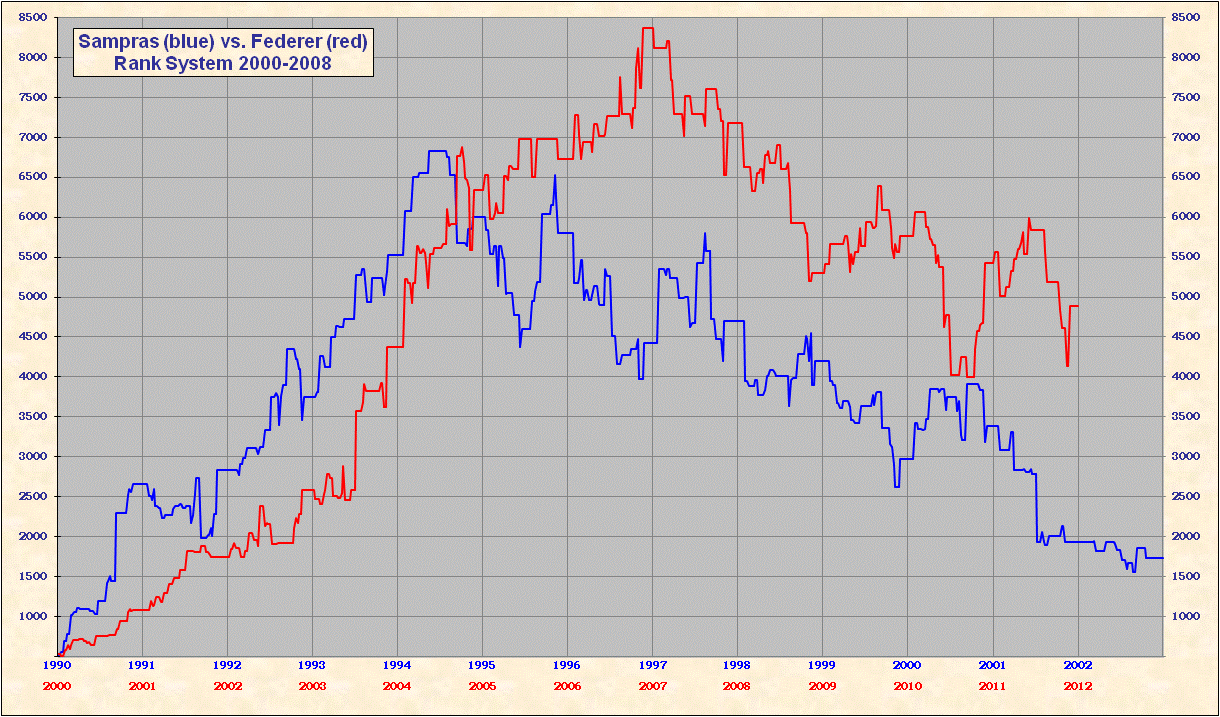
At 6000+ points, you reach (in my book) the Pantheon.  Here's the circle of players who will knock the balls around with Bill Tilden, Ellsworth Vines, Don Budge, Bobby Riggs, Jack Kramer, Pancho Gonzales, Lew Hoad, Rod Laver, Roy Emerson and Ken Rosewall in tennis' Valhalla.  Here we have Pete Sampras, Andre Agassi, Bjorn Borg, Ivan Lendl, Jimmy Connors and John McEnroe - each with seven or more GS titles (and as Rosangel pointed out, maybe more had the Australian Open been a fixture back in their day).  And, of course, Roger Federer.  His loss to David Nalbandian yesterday takes him just below the highest (estimated) ranking achieved in his career by Pete Sampras.  Terminal decline, anyone?

By the way, another statistician has also charted the Federer - Sampras relationship here.  Our methodologies may yield very slightly different numbers, but we see the same patterns.

When it comes to age, it's no surprise to find that it's a young man's game: for the 25 players listed, the average age at which they achieved their highest ranking points total (known or estimated) is 23.9 years.  It's interesting that none of the 25 players I've looked at achieve their maximum ranking points level in their teens, and 9 out of 25 were over 25 when they achieved their highest ATP ranking points.

One final thought before I leave this topic: how strong is the relationship between maximum ranking points and number of Grand Slam titles won?  Pretty strong, it turns out.

Advertising

Charts_chart_18_2

The correlation coefficient between maximum ranking points and Grand Slams won is about 0.8 - not bad.  And that allows me to conclude with one more thought.  If Roger Federer never achieves a higher ranking than the 8370 he reached at the end of 2006, but wins the number of Grand Slam titles predicted in the relationship above - i.e., reaches the red line in the chart - he'll end his career on 17-18 titles.  Not a bad haul for a lad from Basel.

-- Andrew

(Thanks to Rosangel for the photo and suggestions after a first draft.  UPDATE: thanks to Miguel Seabra for pointing out an error in the number of GS titles assigned to WIlander.)